
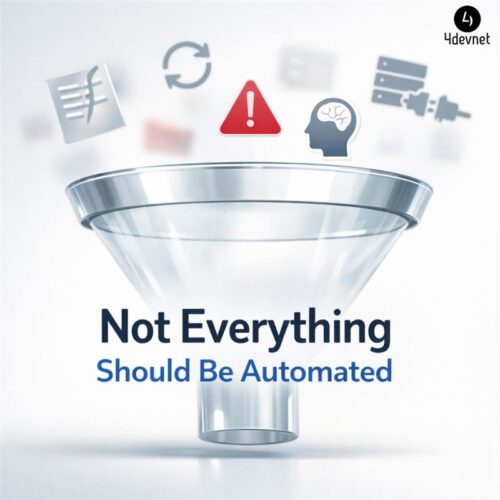
A Strategic Perspective on Business Process Automation
Automation has become one of the most influential forces shaping modern enterprises.
From ERP systems and Odoo implementations to RPA bots, AI-driven workflows, and real-time analytics, organizations today have unprecedented access to automation technologies.
Yet, despite this technological maturity, many automation initiatives fail to deliver the expected return on investment.
The reason is simple but often overlooked:
Automation is a business decision first—not a technical one.
While technology enables automation, strategy determines whether it actually creates value.
The Growing Pressure to Automate Everything
In competitive markets, businesses feel constant pressure to:
- Reduce operational costs
- Increase speed and efficiency
- Minimize human error
- Scale operations without adding headcount
Automation appears to be the obvious solution.
However, this mindset often leads to over-automation, where processes are automated simply because they can be—without evaluating whether they should be.
This approach introduces:
- Rigid workflows that resist change
- High maintenance and customization costs
- User frustration and poor adoption
- Increased dependency on IT teams for minor adjustments
True digital transformation requires selective automation, not blanket automation.
Understanding the Purpose of Business Process Automation
At its core, business process automation exists to:
- Eliminate unnecessary manual effort
- Improve consistency and accuracy
- Enable faster decision-making
- Free employees to focus on higher-value work
When automation does not achieve these outcomes, it becomes a liability rather than an asset.
That’s why successful ERP and RPA implementations begin with process evaluation, not tool selection.
Processes That Deliver the Highest Automation ROI
Certain categories of processes consistently benefit from automation across industries.
1. Repetitive, Rule-Driven Processes
Processes with stable rules and minimal exceptions are ideal candidates for automation.
Examples include:
- Purchase order creation and approvals
- Invoice matching and posting
- Payroll processing
- Inventory updates across systems
- POS and ERP data synchronization
Automating these workflows through ERP systems or RPA tools improves accuracy while significantly reducing processing time.
2. High-Volume Operational Tasks
When a task is performed hundreds or thousands of times daily, automation creates immediate efficiency gains.
Common examples:
- Order confirmations
- Report generation and distribution
- Data transfers between applications
- System alerts and notifications
In such cases, automation reduces workload without compromising decision quality.
3. Compliance and Error-Sensitive Processes
Manual errors in financial and regulatory workflows can be costly.
Automation is highly effective for:
- Tax calculations
- Statutory reporting
- Audit trail generation
- Financial reconciliations
ERP automation ensures compliance, traceability, and consistency across reporting cycles.
Processes That Should Not Be Fully Automated
Despite technological advancements, some processes require human involvement by design.
1. Judgment-Intensive Decision-Making
Processes that rely on experience, context, and qualitative judgment are poor candidates for full automation.
Examples include:
- Vendor evaluations
- Credit and risk assessments
- Strategic pricing decisions
- Exception approvals
AI and analytics can provide insights and recommendations, but final decisions should remain with humans to avoid oversimplification and risk exposure.
2. Customer Experience and Relationship Management
Customer interactions involve emotion, empathy, and nuance—areas where full automation often fails.
Over-automation in:
- Customer support
- Complaint handling
- Relationship management
can damage trust and satisfaction.
A balanced approach uses automation to enable faster access to information, while humans handle communication and resolution.
3. Rapidly Evolving or Immature Processes
Automating unstable processes often results in frequent rework.
Examples:
- Early-stage business workflows
- Pilot projects and experimental operations
- Processes affected by frequent regulatory or policy changes
In these scenarios, manual or semi-automated workflows provide the flexibility needed for evolution.
4. Exception-Heavy Workflows
If a process involves frequent deviations, full automation increases complexity instead of efficiency.
Examples:
- Custom manufacturing orders
- Complex returns and warranty handling
- Project-based billing models
Here, partial automation—such as data aggregation and alerts—delivers better outcomes than end-to-end automation.
Reframing the Automation Decision
Rather than asking:
“Can this process be automated?”
High-performing organizations ask:
- Will automation reduce meaningful effort?
- Will it improve accuracy or decision quality?
- Will it enhance employee or customer experience?
- Can the process remain adaptable after automation?
Automation that restricts flexibility or increases dependency should be reconsidered.
Assistive Automation: The Most Sustainable Model
Modern ERP, RPA, and AI platforms are most effective when they support human intelligence rather than replace it.
Examples of assistive automation:
- Dashboards highlighting anomalies instead of auto-resolving them
- AI-generated recommendations rather than automated approvals
- RPA handling data movement, not judgment
- ERP workflows with human checkpoints at critical stages
This hybrid model ensures scalability while preserving accountability and control.
Automation Success Depends on Process Maturity
Automation should align with:
- Process standardization
- Clear ownership and accountability
- Measurable performance indicators
- Change management readiness
Organizations that automate immature processes often automate inefficiency—scaling problems instead of solving them.
Automation Is a Long-Term Business Strategy
Effective automation initiatives are driven by:
- Business leaders, not just IT teams
- Clear operational goals
- Cross-functional collaboration
- Continuous optimization
Whether implementing ERP systems, Odoo automation, RPA solutions, AI-powered analytics, or Power BI dashboards, success depends on strategic intent rather than tool sophistication.
Conclusion: Automate with Purpose, Not Pressure
Automation is one of the most powerful enablers of modern enterprise growth—but only when applied deliberately.
The most successful organizations are not those that automate everything.
They are the ones that automate what matters, retain human judgment where it adds value, and design systems that evolve with the business.
Because true efficiency is not about speed alone—it’s about making the right decisions, faster and smarter.