
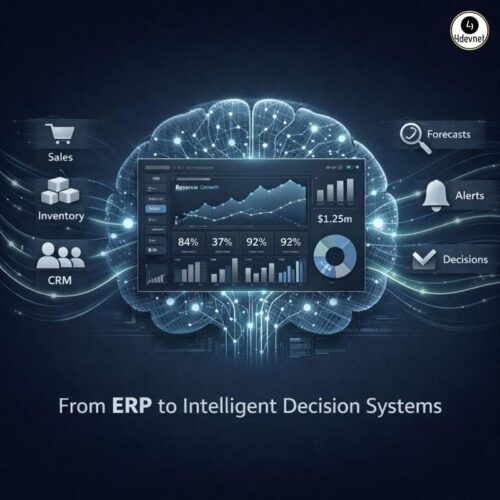
Introduction: From Process Automation to Intelligent Decision Systems
Enterprise Resource Planning (ERP) systems have long been the operational backbone of modern businesses. However, as organizations scale and data volumes grow exponentially, traditional ERP systems are no longer sufficient. Businesses today require systems that can interpret data, anticipate outcomes, and act autonomously.
This evolution has given rise to AI-powered ERP systems—and platforms like Odoo are uniquely positioned to lead this transformation.
By integrating Artificial Intelligence (AI) with Odoo, enterprises can move beyond static workflows and build self-learning ERP ecosystems that continuously evolve based on real-time and historical data.
What Defines a Self-Learning ERP System?
A self-learning ERP system is designed to go beyond execution and reporting. It introduces intelligence into the core of business operations by:
- Continuously learning from transactional and behavioral data
- Predicting trends, risks, and opportunities
- Automating operational and strategic decisions
- Dynamically adapting workflows without manual intervention
In this model, Odoo acts as the centralized data engine, while AI serves as the intelligence layer driving optimization and foresight.
Why Odoo is a Strategic Foundation for AI-Driven ERP
Odoo’s architecture makes it particularly suitable for building intelligent ERP solutions:
1. Unified Data Ecosystem
All business functions—Sales, CRM, Inventory, Manufacturing, Accounting—operate on a single platform, ensuring high-quality, structured data for AI models.
2. Open and Extensible Framework
Odoo supports seamless integration with AI tools and frameworks through APIs, enabling businesses to embed advanced analytics and machine learning capabilities.
3. Modular Scalability
Organizations can introduce AI use cases incrementally across modules, reducing risk while maximizing ROI.
4. Real-Time Data Availability
AI models thrive on fresh data, and Odoo’s real-time processing ensures continuous learning and adaptation.
AI Capabilities Transforming Odoo into a Self-Learning ERP
1. Predictive Demand Forecasting
Business Challenge
Inaccurate demand planning leads to excess inventory, stockouts, and inefficient production cycles.
AI-Driven Approach
Machine learning models analyze:
- Historical sales patterns
- Seasonal variations
- Customer buying behavior
- External variables such as promotions or regional demand shifts
Business Impact
- Improved forecast accuracy
- Optimized inventory levels
- Reduced working capital requirements
Industry Example
A fast-growing FMCG enterprise can leverage AI within Odoo to predict SKU-level demand across multiple geographies, enabling automated procurement and production alignment.
2. Intelligent Decision Automation
Business Challenge
Critical decisions are often delayed due to manual analysis and approval dependencies.
AI-Driven Approach
AI models embedded within Odoo can:
- Automatically approve or flag credit limits
- Recommend optimal pricing strategies
- Trigger purchase orders based on predictive stock levels
- Identify anomalies in financial transactions
Business Impact
- Accelerated decision cycles
- Reduced operational friction
- Enhanced accuracy and consistency
Use Case
In retail, AI can dynamically adjust pricing and promotional strategies in Odoo based on demand elasticity and customer segmentation.
3. Dynamic Workflow Optimization
Business Challenge
Predefined workflows lack flexibility and fail to adapt to real-time operational conditions.
AI-Driven Approach
AI continuously evaluates:
- Process execution times
- Resource utilization
- Bottlenecks and delays
It then recommends or automatically implements:
- Task prioritization
- Resource reallocation
- Process redesign
Business Impact
- Increased throughput
- Improved resource efficiency
- Reduced turnaround time
Use Case
In manufacturing environments, AI-enabled Odoo systems can optimize production schedules dynamically based on machine performance and order urgency.
Reference Architecture: Building an AI-Enabled Odoo Ecosystem
A robust implementation of AI within Odoo requires a layered architectural approach:
1. Data Layer (Odoo ERP Core)
- Centralized repository of structured business data
- Ensures data consistency and integrity
2. Integration Layer
- RESTful APIs for external connectivity
- Middleware for orchestration and data transformation
- Real-time and batch data pipelines
3. AI & Machine Learning Layer
- Predictive models (forecasting, classification, recommendation engines)
- Technologies: Python, ML frameworks, cloud-based AI services
4. Decision Intelligence Layer
- Rule engines combined with AI insights
- Automated triggers and recommendation systems
5. Visualization & Insight Layer
- Advanced dashboards and reporting tools
- Real-time alerts and KPI monitoring
Industry-Wise Applications of Odoo + AI
Manufacturing
- Predictive maintenance
- Production optimization
- Quality anomaly detection
Retail & FMCG
- Demand forecasting
- Customer segmentation
- Dynamic pricing strategies
Logistics & Supply Chain
- Route and delivery optimization
- Inventory prediction
- Warehouse efficiency improvement
Healthcare
- Patient data analytics
- Resource allocation optimization
- Predictive operational planning
Key Benefits of AI-Powered Odoo ERP
- Proactive Decision-Making through predictive insights
- End-to-End Automation across business processes
- Enhanced Operational Efficiency with minimal manual intervention
- Scalable Intelligence aligned with business growth
- Competitive Advantage in a data-driven economy
Implementation Considerations
While the benefits are significant, successful implementation requires:
- High-quality, well-structured data
- Clearly defined use cases with measurable ROI
- Integration expertise across ERP and AI systems
- Continuous monitoring and model optimization
Organizations should adopt a phased implementation strategy, starting with high-impact areas such as demand forecasting or workflow automation.
The Future: Towards Autonomous Enterprises
The convergence of ERP and AI is paving the way for autonomous enterprises, where systems:
- Predict and respond to changes in real time
- Continuously optimize operations
- Minimize human intervention in routine decisions
Odoo, when enhanced with AI capabilities, becomes more than an ERP—it evolves into a strategic intelligence platform.
Conclusion
Integrating AI with Odoo represents a fundamental shift from operational management to intelligent enterprise orchestration.
By enabling predictive analytics, automated decision-making, and adaptive workflows, businesses can transform their ERP systems into self-learning ecosystems that drive sustained growth and innovation.
Organizations that embrace this transformation today will be better positioned to lead in an increasingly competitive and data-centric business landscape.