
Introduction
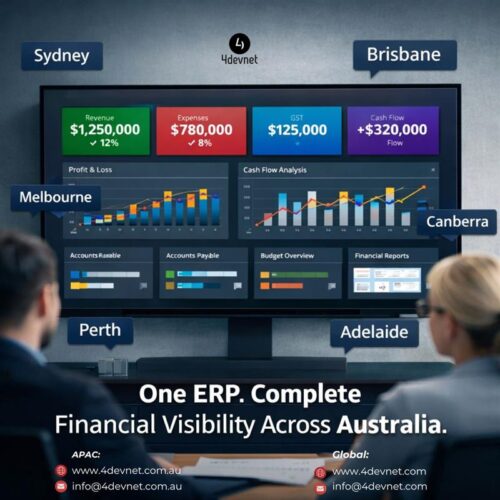
For Australian small and medium-sized enterprises (SMEs) operating in cities like Sydney, Melbourne, Brisbane, Perth, Adelaide, and Canberra, financial reporting is no longer limited to statutory compliance. It has become a critical driver for strategic planning, cash flow optimisation, investor readiness, and sustainable growth.
However, many SMEs across Australia still rely on manual spreadsheets, disconnected accounting tools, or legacy finance systems. These approaches often lead to reporting delays, data inconsistencies, compliance risks, and limited financial visibility—especially for growing businesses in competitive metropolitan markets.
This is where financial reporting automation using ERP systems plays a vital role. ERP solutions help Australian SMEs across major cities automate reporting, ensure ATO compliance, reduce finance workload, and gain real-time financial insights.
Understanding Financial Reporting Automation in ERP
Financial reporting automation uses an Enterprise Resource Planning (ERP) system to automatically capture, process, reconcile, and generate financial reports without repetitive manual work.
For SMEs in Sydney and Melbourne, where multi-entity operations and higher transaction volumes are common, ERP ensures financial consistency across locations. Meanwhile, SMEs in Brisbane, Perth, and Adelaide benefit from centralised reporting that supports remote operations and multi-branch visibility.
Key ERP financial modules include:
- General Ledger and Chart of Accounts
- Accounts Payable and Receivable
- Payroll and employee expenses
- GST, BAS, and ATO compliance
- Budgeting, forecasting, and variance analysis
- Fixed assets and depreciation
Financial Reporting Challenges Faced by Australian SMEs
Manual Reporting and Spreadsheet Dependency
Across cities like Melbourne and Sydney, many SMEs still rely on Excel-based reporting, which increases the risk of errors, inconsistent formats, and lack of version control.
Compliance Complexity Across Australia
Australian SMEs—whether based in Canberra, Brisbane, or Perth—must comply with:
- Australian Taxation Office (ATO) regulations
- GST reporting
- Business Activity Statements (BAS)
- PAYG withholding
- Single Touch Payroll (STP)
Manual compliance reporting increases audit risk and administrative overhead.
Lack of Real-Time Financial Visibility
Without ERP automation, businesses often rely on historical data, making it difficult for SME owners in fast-moving markets like Sydney and Melbourne to respond quickly to financial changes.
How ERP Automates Financial Reporting for Australian SMEs
Centralised Financial Data Across Locations
ERP provides a single source of truth, enabling SMEs with offices in Sydney, Melbourne, and Brisbane to consolidate financial data across branches and departments.
Real-Time Financial Reporting
ERP allows SMEs in Perth, Adelaide, and Canberra to generate real-time reports such as:
- Profit & Loss statements
- Balance Sheets
- Cash Flow reports
- Trial Balances
This enables faster decision-making regardless of business location.
Automated GST, BAS & ATO Compliance
ERP systems built for the Australian market automate:
- GST calculations
- BAS preparation
- ATO-compliant tax structures
- Audit trails
This is especially beneficial for SMEs operating across multiple Australian states.
Key Benefits of Financial Reporting Automation Using ERP
Improved Accuracy and Financial Control
ERP eliminates manual errors and ensures consistent reporting for SMEs in Sydney, Melbourne, Brisbane, and beyond.
Time and Cost Efficiency
Finance teams across Australia can focus more on analysis and strategy, rather than repetitive reporting tasks.
Better Cash Flow Management
Real-time visibility into receivables and payables helps Australian SMEs manage liquidity more effectively, particularly in high-cost cities like Sydney and Melbourne.
Scalable Growth for Australian Businesses
ERP supports multi-location and multi-entity growth, making it ideal for expanding SMEs in Brisbane, Perth, and Adelaide.
ERP and Power BI for Advanced Financial Reporting
Many Australian SMEs combine ERP systems with Power BI to enhance financial reporting and analytics.
This approach is widely adopted by finance teams in Sydney and Melbourne, enabling:
- Interactive dashboards
- Budget vs actual reporting
- Forecasting and trend analysis
- Executive-level financial insights
Industry Adoption Across Australian Cities
ERP-based financial reporting automation is widely used by SMEs across:
- Manufacturing hubs in Melbourne and Adelaide
- Construction companies in Sydney and Brisbane
- Retail and eCommerce businesses in Perth and Melbourne
- Logistics and professional services firms in Sydney and Canberra
Each industry benefits from customised financial workflows and city-specific compliance needs.
Choosing the Right ERP Partner in Australia
When selecting an ERP solution, Australian SMEs should consider:
- Local compliance expertise (ATO, GST, BAS, STP)
- Cloud ERP accessibility for teams across multiple cities
- Integration with Australian payroll and banking systems
- Experience delivering ERP projects in Sydney, Melbourne, Brisbane, Perth, and Adelaide
A reliable ERP implementation partner ensures smoother adoption and faster ROI.
Conclusion
For Australian SMEs across Sydney, Melbourne, Brisbane, Perth, Adelaide, and Canberra, financial reporting automation using ERP is no longer optional. It is a strategic necessity for compliance, accuracy, and scalable growth.
By adopting ERP-driven financial reporting, Australian businesses gain real-time visibility, regulatory confidence, operational efficiency, and smarter financial decision-making—regardless of location.