
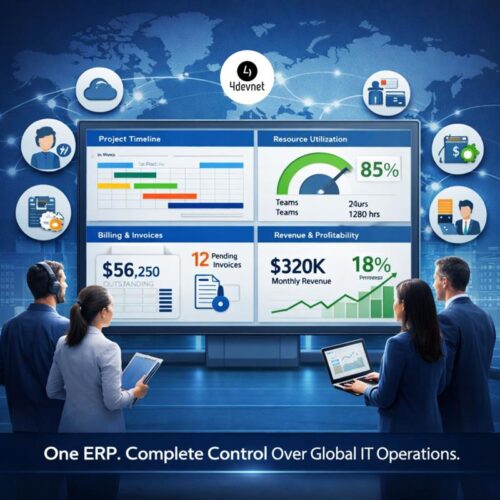
Introduction: The New Reality of Global IT Operations
The modern IT company no longer operates from a single office or serves a limited market. Software development firms, IT service providers, SaaS companies, and technology consultancies now work with global clients, distributed teams, and complex project delivery models. While this global reach creates growth opportunities, it also introduces operational challenges that traditional tools simply cannot handle.
To remain competitive, IT companies must adopt systems that offer centralized control, real-time visibility, and scalable operations. This is where ERP for IT companies plays a critical role. A robust ERP system helps organizations manage projects, billing, resources, and financials across geographies—all within one integrated platform.
What is ERP for IT Companies?
An ERP (Enterprise Resource Planning) system for IT companies is a business management platform designed specifically to handle project-based operations, human resources, billing, finance, and analytics. Unlike generic ERP solutions, IT-focused ERP systems are built to support:
- Project-centric workflows
- Time and effort-based billing
- Multi-client and multi-region operations
- Remote and hybrid workforce management
- Real-time financial and performance reporting
By unifying all core business processes, ERP becomes the digital backbone of a growing IT enterprise.
Why ERP is Essential for Global IT Companies
As IT companies scale internationally, operational complexity increases exponentially. ERP systems help eliminate silos and provide end-to-end process visibility.
Key Reasons IT Companies Need ERP:
- To manage multiple projects across regions efficiently
- To ensure accurate and timely client billing
- To optimize resource utilization and workforce planning
- To gain real-time financial insights
- To comply with international accounting and tax regulations
Without ERP, IT companies often rely on disconnected tools that limit scalability and increase operational risk.
Common Challenges Faced by IT Companies Without ERP
1. Fragmented Project Management
Managing projects across multiple tools leads to poor coordination, missed deadlines, and budget overruns.
2. Revenue Leakage & Billing Errors
Manual or semi-automated billing processes often result in unbilled hours, delayed invoicing, and disputes.
3. Inefficient Resource Allocation
Lack of visibility into team availability and skill sets causes underutilization or burnout.
4. Financial Blind Spots
Disconnected finance systems make it difficult to track profitability at project, client, or regional levels.
5. Limited Scalability
As the organization grows, existing systems fail to support new regions, currencies, and compliance requirements.
How ERP Transforms Project Management in IT Companies
End-to-End Project Lifecycle Management
ERP systems allow IT companies to manage the entire project lifecycle from a single platform:
- Project estimation and costing
- Task and milestone planning
- Time and effort tracking
- Budget vs actual cost monitoring
- Project performance analysis
This structured approach improves delivery predictability, accountability, and client satisfaction.
Improved Collaboration for Global Teams
With centralized project data, teams across different countries can collaborate seamlessly. Managers gain real-time visibility into project progress, reducing dependency on manual updates.
ERP-Driven Billing & Revenue Management
Supporting Multiple Billing Models
Modern ERP systems support flexible billing structures commonly used by IT companies, such as:
- Time & Material (T&M) billing
- Fixed-price contracts
- Milestone-based invoicing
- Retainer-based agreements
- Subscription billing for SaaS companies
Automation That Improves Cash Flow
By automating billing workflows, ERP ensures:
- Accurate capture of billable hours
- On-time invoice generation
- Reduced billing disputes
- Faster revenue realization
This results in improved cash flow and financial stability.
Smart Resource Management for Distributed IT Teams
Optimizing Workforce Utilization
ERP enables IT companies to align the right talent with the right projects by providing:
- Skill-based resource mapping
- Capacity and utilization analysis
- Availability forecasting
- Resource demand planning
This ensures higher productivity while preventing employee burnout.
Managing Remote & Hybrid Teams
With global teams becoming the norm, ERP systems help standardize HR processes, track productivity, and manage workforce performance across locations.
Financial Management & Compliance at a Global Scale
Integrated Financial Operations
ERP systems integrate all financial data—projects, payroll, expenses, and billing—into a single source of truth.
Key benefits include:
- Multi-currency accounting
- Automated tax calculations
- Region-specific compliance handling
- Accurate revenue recognition
Real-Time Profitability Insights
IT companies can track:
- Project-level profitability
- Client-wise margins
- Region-wise revenue performance
This empowers leadership to make strategic, data-driven decisions.
Advanced Analytics & Business Intelligence
ERP systems provide real-time dashboards and analytics that help IT leaders:
- Monitor project health
- Forecast revenue and growth
- Analyze resource utilization
- Identify operational bottlenecks
With actionable insights, ERP transforms data into competitive intelligence.
ERP Benefits Across Different IT Business Models
IT Services & Consulting Firms
- Better project control and transparency
- Accurate billing and cost management
- Improved client trust
Software Development Companies
- Streamlined agile project execution
- Enhanced team coordination
- Predictable delivery timelines
SaaS Companies
- Subscription billing automation
- Scalable revenue management
- Compliance with global accounting standards
Selecting the Right ERP for IT Companies
When choosing an ERP solution, IT companies should evaluate:
- Project and resource management capabilities
- Flexible billing and financial modules
- Scalability for global expansion
- Customization and integration options
- Cloud readiness and security
Platforms like Odoo and ERPNext are increasingly popular due to their modular design, flexibility, and cost-effectiveness.
How 4devnet Enables ERP Success for IT Companies
At 4devnet, we deliver industry-specific ERP implementations tailored for IT companies operating globally. Our approach focuses on aligning ERP capabilities with real business needs.
Our ERP Services Include:
- ERP consulting and system design
- Odoo & ERPNext implementation
- Custom module development
- Integration with existing tools
- Ongoing support and optimization
We help IT companies gain operational efficiency, financial transparency, and scalable growth.
Conclusion: ERP as a Strategic Growth Enabler
For IT companies managing projects, billing, and resources across borders, ERP is not just a software solution—it is a strategic growth enabler. By centralizing operations and providing real-time insights, ERP empowers IT businesses to scale globally with confidence. Investing in the right ERP system today ensures long-term efficiency, profitability, and competitive advantage in the evolving global IT landscape.