
Introduction
In today’s fast-paced retail and service environments, businesses are increasingly challenged to manage sales, inventory, and customer interactions efficiently. Standalone Point of Sale (POS) systems can process transactions effectively, but without integration with an Enterprise Resource Planning (ERP) system, organizations often struggle with disconnected data, inaccurate inventory levels, and inefficient reporting workflows.
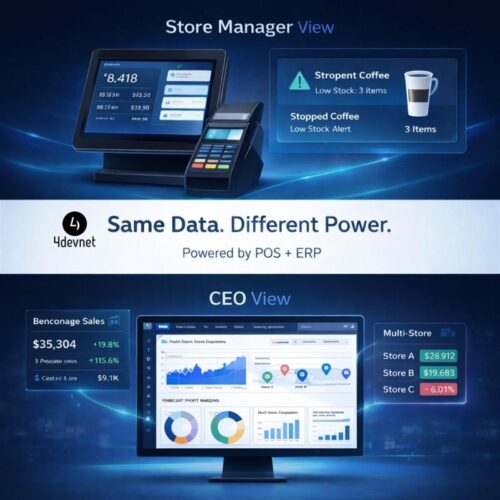
POS integration with ERP addresses these challenges by creating a unified ecosystem where sales, inventory, accounting, and customer management processes work in harmony. By linking your POS to ERP software, businesses gain real-time insights, streamline operations, reduce errors, and improve the overall customer experience.
What is POS Integration with ERP?
POS integration with ERP involves connecting your point-of-sale system directly to your ERP platform. This integration ensures real-time synchronization of data, enabling automatic updates across sales, inventory, finance, and other business modules.
Key Features of POS-ERP Integration
- Real-time stock updates after every sale or return
- Automatic financial postings to accounting modules
- Unified customer databases across multiple sales channels
- Multi-store and multi-channel data consolidation
With these capabilities, businesses can eliminate redundant tasks, reduce human errors, and gain accurate insights to make strategic decisions.
Why POS Integration with ERP is Essential
1. Enhanced Inventory Accuracy
Without integration, businesses often rely on manual stock reconciliation, leading to errors and stock-outs. Integrated systems:
- Update inventory in real-time across all locations
- Improve demand forecasting and replenishment planning
- Reduce carrying costs by preventing overstock situations
Example: A retail chain using ERP-integrated POS can prevent a customer from buying out-of-stock items while ensuring warehouse stock is replenished proactively.
2. Centralized Reporting and Analytics
An integrated POS-ERP system provides consolidated reports across multiple channels and locations:
- Unified sales data and financial statements
- Insightful analytics on top-selling products and customer behavior
- KPI tracking for inventory turnover, revenue per store, and employee performance
Stat: According to a report by Aberdeen Group, companies with integrated ERP and POS systems experience 15-20% faster decision-making due to accurate real-time data.
3. Improved Customer Experience
POS integration allows businesses to personalize interactions and streamline the shopping experience:
- Access complete purchase history across channels
- Enable loyalty programs, discounts, and personalized offers
- Reduce checkout times and improve service efficiency
Case Study: A fashion retail store using integrated ERP-POS systems could alert staff to customer preferences and purchase history in real-time, boosting customer satisfaction and repeat purchases.
4. Streamlined Financial Management
Manual financial entries are time-consuming and prone to errors. Integrated systems:
- Automatically update accounting ledgers with POS transactions
- Simplify tax calculations, invoicing, and reconciliation
- Reduce manual data entry errors, saving time and cost
This ensures finance teams spend less time on routine tasks and more on strategic planning.
5. Multi-Channel Retail Management
Modern retail is omnichannel, combining in-store, eCommerce, and mobile sales. Integration ensures:
- Consistent pricing, promotions, and stock levels across channels
- Real-time visibility into orders and inventory
- Improved customer satisfaction by avoiding discrepancies
Example: A grocery chain with multiple stores and an online platform can automatically reflect sold-out items online, preventing customer frustration and potential revenue loss.
Challenges of POS-ERP Integration
While the benefits are substantial, businesses may encounter challenges during implementation:
- Compatibility Issues – Not all POS systems integrate seamlessly with every ERP solution.
- Complex Data Migration – Transferring historical sales and inventory data can be time-consuming.
- Employee Training Requirements – Staff must adapt to new workflows and reporting systems.
- Implementation Costs – Upfront investment in integration tools or ERP-ready POS may be significant for small businesses.
Tip: Partnering with an experienced ERP vendor or consultant can mitigate these challenges and ensure smooth integration.
Best Practices for Successful POS-ERP Integration
- Select Compatible Systems – Choose ERP and POS software designed for seamless integration.
- Document Business Processes – Map out sales, inventory, and financial workflows before implementation.
- Pilot the Integration – Test with limited data or a single store to identify potential issues.
- Train Employees Thoroughly – Ensure all staff understand the new processes and system features.
- Monitor KPIs Continuously – Use dashboards to track sales, inventory turnover, and operational efficiency.
Industries That Benefit Most from POS-ERP Integration
- Retail and FMCG – Efficient inventory and omnichannel sales management
- Hospitality – Restaurants, cafes, and hotels benefit from integrated order and stock management
- Fashion and Apparel – Track product variations such as sizes, colors, and seasonal collections
- E-commerce – Synchronize online orders with warehouse and accounting systems
The Future of POS and ERP Integration
With the rise of cloud ERP, AI-driven analytics, and mobile POS, integration is evolving into a strategic advantage rather than just a convenience. Retailers are now able to:
- Predict customer demand using AI analytics
- Offer personalized omnichannel experiences
- Optimize supply chains in real-time
Businesses that adopt integrated POS and ERP systems can scale efficiently, reduce operational costs, and enhance customer satisfaction, gaining a competitive edge in today’s dynamic market.
Conclusion
POS integration with ERP is no longer an optional upgrade; it is a critical enabler for modern retail efficiency. From real-time inventory updates to consolidated reporting, financial accuracy, and enhanced customer experiences, the benefits of integration are undeniable.
Businesses that leverage this integration can streamline operations, minimize errors, and make data-driven decisions, positioning themselves for growth in an increasingly competitive environment.